The Bargain (1914)
We hope you will enjoy the following film. Please consider making a donation so that we can continue preserving films and presenting them on our Web site. Thank you!
The film will start in 0 seconds.

Film showing the Bayshore Amusement Park in its heyday, preserved by the Maryland Historical Society with NFPF support.
We hope you will enjoy the following film. Please consider making a donation so that we can continue preserving films and presenting them on our Web site. Thank you!
The film will start in 0 seconds.
The Bargain (1914)
Production Co.: New York Motion Picture Corp. Distribution Co: Paramount Pictures Corporation. Producer: Thomas H. Ince. Director: Reginald Barker. Camera: Joseph H. August or Robert Newhard. Story: William H. Clifford, Thomas H. Ince, and Richard V. Spencer. Cast: William S. Hart (Jim Stokes), J. Frank Burke (Sheriff Bud Walsh), J. Barney Sherry (Phil Brent), James Dawley (Wilkes the Minister), and Clara Williams (Nell Brent). Transfer Note: Scanned from a 35mm print preserved by the Library of Congress. New Music: Ben Model. Running Time: 80 minutes.
The NFPF wishes to thank the National Film Preservation Board for allowing the reproduction of this Program Note, originally created for the National Film Registry. The Bargain was added to the Registry in 2010.
The story of the making of this film goes back to the cold winter of 1903, when two out-of-work actors, Thomas Ince and William S. Hart, first met. They were broke, and decided to share rooms at Broadway and 44th Street for $9.50 a week. They were so short of money that they subsisted on cheap stale bread, eaten with a tin of beans. In their dark apartment, Hart told stories of the Sioux Indians he had known as a boy in the Dakotas. At last money gave out completely and the threesome had to go their separate ways into the snow.
Nine years later, in the sunshine of Los Angeles, Hart was touring in a stage version of The Trail of the Lonesome Pine. He visited his old friend Ince, now a leading producer, at his stu-dio, known as Inceville. The 101 ranch’s personnel had performed in Ince’s western films for two years amid the Santa Monica mountains, and Hart recalled it in overblown style. “The very primitiveness of the whole life out there, the cowboys and the Indians, staggered me. I loved it. They had everything to make Western pictures. The West was right there!”
Yet Hart arrived at the very time when Ince’s own output of westerns was in decline, and he discouraged Hart’s dream of placing the “real West” on celluloid, offering him $75 a week, less than his stage salary. Ince thought that Hart, at age 50, might want to aim for a career as director rather than star. However, Hart had already had success in adapting his childhood memories into a stage persona that convinced audiences, and believed he could do the same for the cinema. In May 1914, Hart began to appear in two-reel shorts for Ince. His Hour of Manhood was the first, taking 12 days to film on a budget of $8,000. The filmmaking process left Hart uncomfortable, but he wanted to try a feature, shot over a much longer period, June 11 to August 5, 1914.
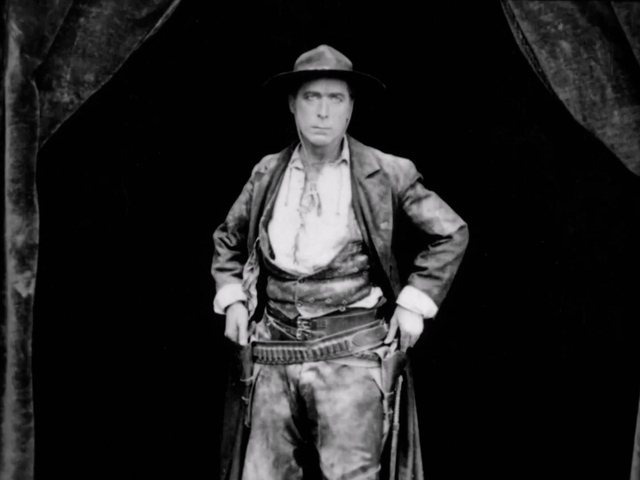
Hart’s personal note of authenticity in the resulting movie, The Bargain, is apparent from the opening credits, when the major players are all introduced, bowing between curtains as they fade into their costume for the role they play in The Bargain. Unlike the other male leads (J. Frank Burke, J. Barney
Sherry, and James Dowling), only Hart’s visage is not obscured behind heavy makeup. The viewer is left to conclude that, unlike the others, Hart is what he seems—the only difference is the actor in evening dress versus cowboy regalia. He needs no false whiskers or wig to be a man of the West. One of his subsequent directors, Lambert Hillyer, recalled that Hart "tried to live the West in every picture, loved authentic props, costumes etcs. [sic], and allowed me to go to any lengths to get things perfect.”
Not all were so convinced; the cowboys of the 101 found Hart to be patently false in his attempts to be “one of them.” An opening pan of Grand Canyon vistas, shot during a location trip, was underlined with a flight of purple prose that would seem to be at odds with its ostensible realism. “The West! The Land of Vast Golden Silences Where God Sits Enthroned on the Purple Peaks and Man Stands Face to Face With His Soul.” Telegraph notes reveal the setting is the year 1889.
The Bargain establishes the pattern of the character types, trajectory, and conflicts which would become the Hart persona. He is the daring outlaw Jim Stokes, a self-sufficient “two-gun man” first seen rolling a cigarette. His devil-may-care confidence allows him to rob even a well-guarded stagecoach alerted to his presence in the area; he sets up hats and rifles behind boulders and convinces the escort that he his confederates are watching them. But once he leaves with the money chest, the guards realize the ruse, pursuing Stokes into the badlands and wounding him.
Found by prospector Phil Brent (Sherry), Stokes is nursed back to health, winning the love of the pro-spector’s daughter Nell (Clara Williams). They are unaware of Stokes’s criminal past. While not losing his courage and resourcefulness, love has brought about a moral reformation, and Stokes determines to return the money to the stage company.
Another feature of similar length for Ince was begun by Hart the day after completing The Bargain. In On the Night Stage (also known as The Bandit and the Preacher), Hart—fourth-billed after Robert Edeson, Rhea Mitchell, and Herschell Mayall—again plays the bad man redeemed, a stagecoach robber who sees his dance-hall sweetheart transformed and ultimately wed by a newly-arrived minister. He helps to save her when a devious friend tries to place her in a compromising situation, and Hart ultimately ends, alone, with his horse, returning to his life of crime. Despite the billing, Hart was already advertised in Reel Life (April 10, 1915) as “the most talked of Motion Picture Actor today (His wonderful work in The Bargain will go down in the history of Motion Pictures)....”
Hart returned to Inceville in October 1914 to both star and co-direct. He became an international celebrity (known in France as “Rio Jim”), one of the leading stars of the silent cinema. However, by the early 1920s his career was all but over, replaced by flashier cowboys like Tom Mix. Although Hart and Ince split acrimoniously, Hart’s best films were those under his mentor’s supervision. Hart lived long after departing the screen, finally passing away in 1946 at age 81. His ranch outside Los Angeles today is preserved and is open to visitors. His legacy lives on in the western film motif of the “good-bad man” he did so much to codify: the outlaw who achieves redemption. Whenever authenticity, and moral ambiguity, are portrayed in the western on the screen, the genre is echoing William S. Hart. — Brian Taves
Brian Taves (1959-2019) served a quarter-century as a film archivist with the Library of Congress. He was the author of Thomas Ince: Hollywood's Independent Pioneer (University Press of Kentucky, 2012), the first book-length work on the subject. His other books included Hollywood Presents Jules Verne: The Father of Science Fiction on Screen (University Press of Kentucky, 2015), P. G. Wodehouse and Hollywood: Screenwriting, Satires and Adaptations (McFarland, 2006), The Romance of Adventure: The Genre of Historical Adventure Movies (University Press of Mississippi Press, 1993) and Robert Florey, the French Expressionist (Scarecrow Press, 1987).
About the Preservation
A 35mm paper print of The Bargain, created for the purpose of copyright, was deposited at the Library of Congress in 1914. This proved to be the earliest, best, and most complete source. Grants from the National Film Preservation Foundation, awarded in 2001 and 2002, funded the creation of a new celluloid negative and master, accomplished by scanning the paper print and outputting the results to standard polyester film.
About the Music
Ben Model is one of the nation’s leading silent film accompanists, performing on both piano and theatre organ. Over the past 44 years, he has created and performed thousands of live scores for silent films at universities, museums, and historic theaters. He is a resident film accompanist at the Museum of Modern Art (NY) and at the Library of Congress’ Packard Campus Theatre, and accompanies silents at classic film festivals around the USA and internationally. Ben’s Blu-ray/DVD label Undercrank Productions works with archives and collectors to bring undiscovered gems of silent cinema to fans. He is the producer and co-founder of The Silent Clowns Film Series, now celebrating its 27th season in NYC, and is also a Visiting Professor of Film at Wesleyan University, where he teaches a course on silent film history. His book The Silent Film Universe was published in 2025.